
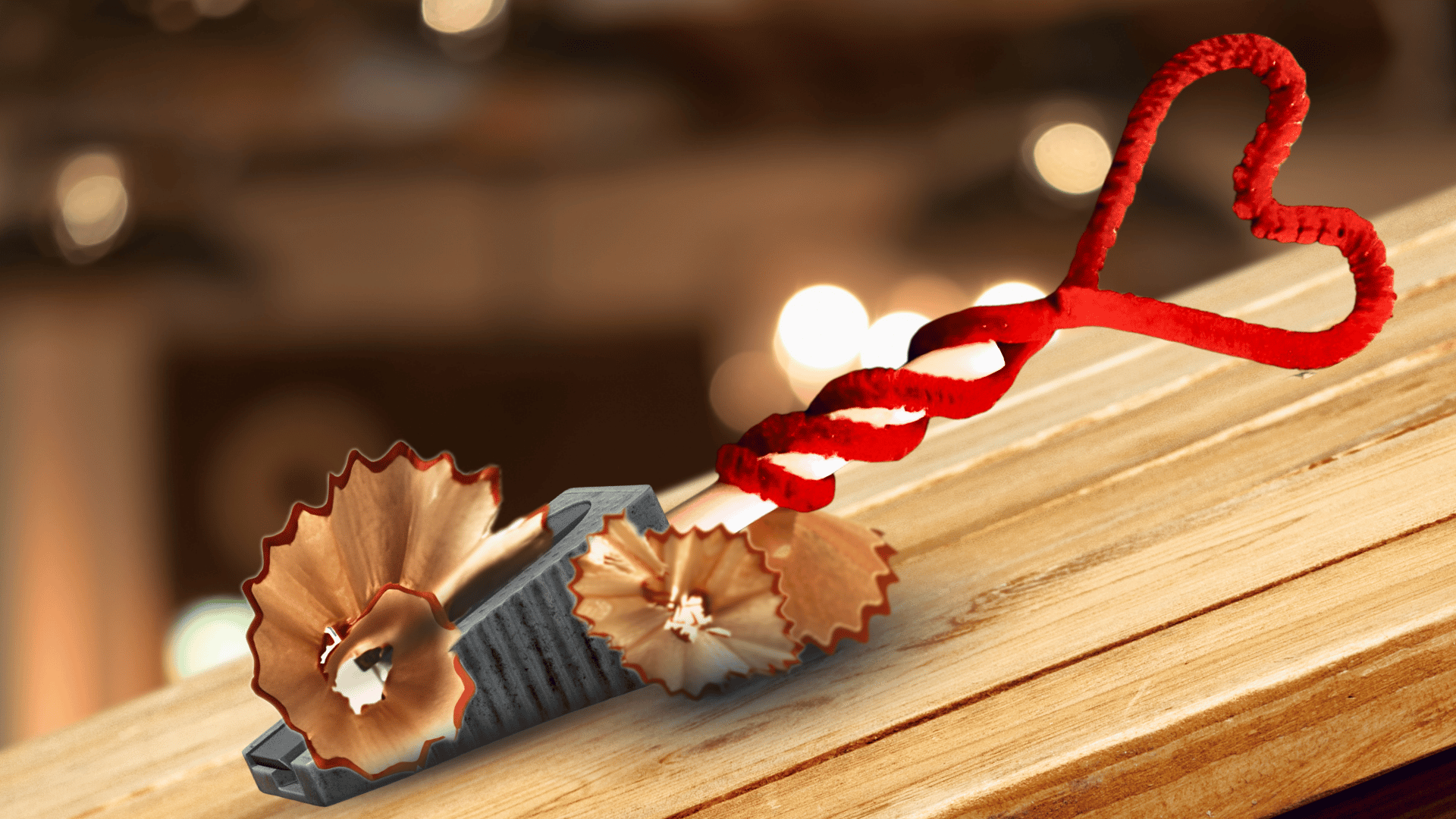
Love has the lifespan of a pencil.
Fresh from the box, untouched, and whole, a pencil is needed for its potential. It is valued before having written a single word, before it has made a single mistake. Yet, its purpose is fulfilled only when it is used. With every sentence written, and every sketch drawn, its tip grows dull and its body grows small. It sacrifices pieces of itself to leave something meaningful behind.
Love is the same.
At first, it appears simple. It is mistaken for grand gestures, perfect moments, and beautiful words. But as time passes, love is sharpened by hardships, sacrifices, and change. It loses its polished appearance. It becomes worn. Yet in being worn, it feels real because it leaves meaning.
Love is equivocal. Love is different, and it feels like ours even if it isn’t. The essence of love has evolved from a biological instinct that ensured survival into something greater—a reason to live, a cause to endure, and a means to thrive. The death of an author is the death of stories left unwritten. In the same way, the loss of a lover is the loss of possibilities that can never come. Every relationship carries an invisible future of conversations and moments that may never happen. When love ends, we do not just lose a person; we lose a version of ourselves that existed with them.
Yet despite the risk of loss, people continue to love.
Aristotle once said: “Love is composed of a single soul inhabiting two bodies.” We spend our lives balancing the tensions between ‘me’ and ‘we’, between preserving individuality and finding belonging. Modern society often mistakes interdependence for weakness, teaching us that needing is a flaw. Yet genuine love does not erase individuality, it allows two people to remain whole while choosing to walk through life hand-in-hand. When you love, perfection is no longer the goal. It is the fragility of knowing that it is okay to shatter, and instead of breaking, you grow stronger.
In an article from Harvard Medical School entitled, “The Science of Love”, it is stated that humanity has attempted to explain love. Philosophers have rationalized it, artists have created it, scientists have measured it, and psychologists have analyzed it. Despite these countless attempts, love continues to resist complete explanation because it was never meant to be rational. Love does not exist as a transaction or calculation. It does not keep score. It does not emerge from logic. It embraces the irrational, the imperfect, and the stupid. It bypasses polite etiquette as love is not a careful curation placed in museums for viewing. Love is violent, irrational, and vulnerable, but that is what makes it comfortable. To know that you are loved and understood despite being you, and just because you are you.
45% of 18 to 29 year olds report that the internet deeply impacted their romantic lives, with initial connections and the expression of love revolving around the digital era. Love has been curated rather than lived as an experience. Relationships become edited highlights, presented for admiration. Endless scrolling creates the illusion of infinitesimal possibilities, convincing people that someone better may be waiting beyond the screen. As a result, many hesitate to commit, fearing mistakes instead of embracing it as a means to learn. The abundance of choice has created a paradox. Despite the infinite connectivity, loneliness remains widespread. We have perfected the appearance of intimacy while struggling to cultivate what makes it real.
Love was never meant to be flawless. It was meant to be human.
It is inevitable that every love story encounters mortality. People leave, circumstances change, and time moves forward. While love may seem temporary, its impact is not. The presence of love changes us permanently. It shapes who we are, and leaves traces of itself within us long after its means. It serves as a reminder that our lives become richer when shared. When the risk of love offers something equally powerful: belonging.
The shavings of a pencil symbolize its gradual disappearance. They are visible reminders of everything it has given away. Eventually, the pencil becomes an obituary of words that could have been, but were never meant to be written.
Love leaves no shavings.
It leaves no residue, no tangible evidence that it once existed. Somehow, it endures longer than anything else. It survives in memories, in lessons, and in the people we become because someone once cared.
A pencil may disappear after fulfilling its purpose, but its words can last for generations.
Just like a pencil, love will always be ours—even when it feels like it isn’t.