

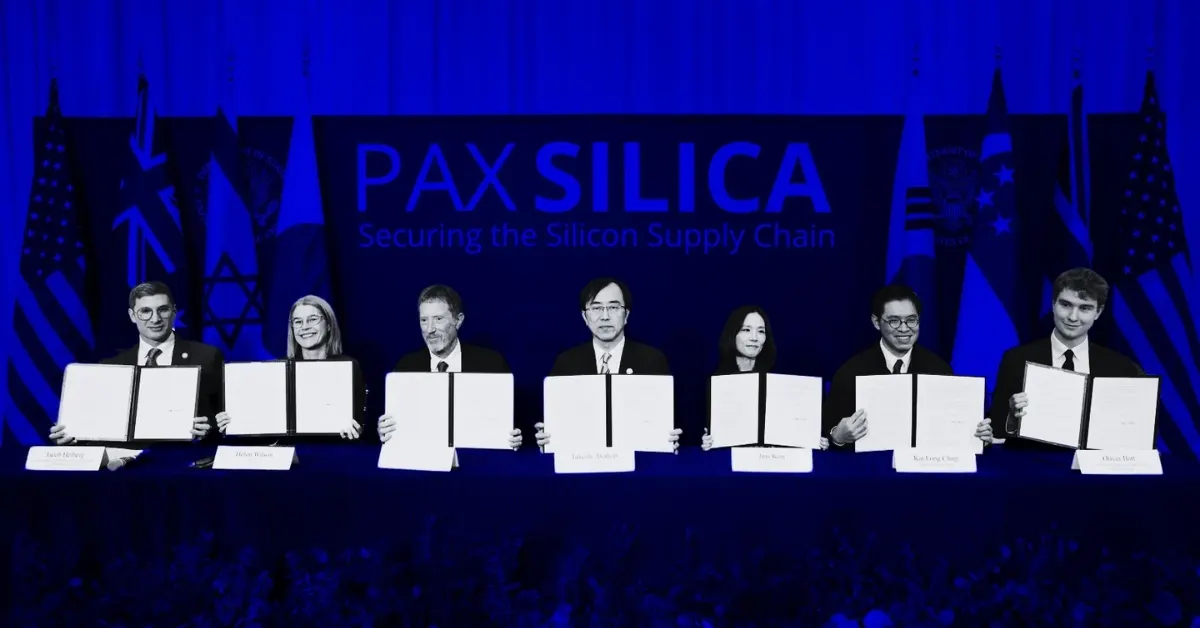
In April 2026, the Philippines quietly joined a coalition few Filipinos have heard of — and in doing so, put 4,000 acres of Tarlac soil on the table for a foreign power. The deal is called Pax Silica, and it’s being sold as the country’s ticket into the future of artificial intelligence and semiconductor manufacturing.
What exactly did the Philippines sign up for? Who gets to decide what happens on that land? And why has a transaction this consequential unfolded with so little public scrutiny?
Would the Philippines give up 4,000 acres of land to a foreign power?
Imagine a foreign power asking for 4,000 acres of your land, and your government saying yes. That is not a hypothetical situation, because it is happening right now, in Tarlac, and most Filipinos have never even heard of it.
What is Pax Silica, and what’s the ‘Golden Node’?
On the surface, it sounds like a dream. It is a strategic coalition launched by the United States in late 2025 to strengthen allied control over technologies considered essential to economic and national security. The Philippines joined as the 13th member nation. But what exactly did we sign up for?
The government is offering a massive piece of land in New Clark City, handed over to become what officials call a ‘Golden Node’. The Bases Conversion and Development Authority (BCDA)
has allocated a 4,000-acre lot in New Clark City to serve as Pax Silica Coordination Office where technology firms, research institutions, and government agencies can converge to build a robust AI ecosystem. Sounds impressive until you read the fine print.
An economic security zone or a sovereignty question? What does the Constitution say?
The fine print is where things get alarming. Reports attributed to Jacob Helberg, the US Undersecretary of State for Economic Affairs, suggested that the United States would occupy the site rent-free for two years, administer it as a special economic zone, and that the hub would enjoy diplomatic immunity-like protections and operate under US common law.
The Constitution is clear: sovereignty resides in the people, public interest transactions require full disclosure, and foreign facilities cannot simply materialize without proper legal and legislative processes. And yet 4,000 acres are potentially subject to arrangements that have neither been transparently explained nor publicly debated—no Senate concurrence, no meaningful consultations, no clear legal framework.
Too close for comfort: dragged into a war we didn’t choose?
There is also the military question, because this zone does not exist in a vacuum. The Clark hub is adjacent to existing military installations under the Enhanced Defense Cooperation Agreement, the 2014 executive agreement that governs the terms of the return of American military bases to the Philippines. For analysts, the proximity raises legitimate questions about whether an economic zone producing AI and semiconductor technology could become entangled with military objectives, whether the Philippines intends it to or not.
Some legislators have argued that Pax Silica, along with a broader US-Philippines critical minerals framework, would create a pipeline from resource extraction to semiconductor and electronics production, and that advanced chips and electronics produced under such arrangements could be used in military technologies, including drones, missiles, and surveillance systems.
Who pays the real price?
And the environmental cost? It lands hardest on those who have the least power to fight back. Approximately 72 to 75 percent of mining permit applications in 2024 were located within the ancestral domains of indigenous people, and Pax Silica’s demand for critical minerals could push that number even higher, displacing communities and destroying watersheds that entire villages depend on.
The promise: Jobs, technology, and a seat at the table
Supporters of Pax Silica said this misses the bigger picture. Finance Secretary Frederick Go has argued that by joining Pax Silica, the Philippines is ensuring that its mineral resources and strategic location are not simply supporting global industries from the margins, but are actively harnessed to build the industries of the future.
Rich land, foreign profits—a pattern we’ve seen before
But Philippine economists are asking the harder question—even if the investment comes, who actually benefits? The University of the Philippines School of Economics (UPSE) has warned that the country risks remaining a mere host for foreign-led AI and semiconductor investments unless it develops stronger domestic technological and industrial capabilities.
The terms are still being written—are Filipinos at the table?
This is not the first time the Philippines has stood at this crossroads, and it will not be the last. The question was never whether progress is possible—it is whether the price is worth it. No national debate has taken place. There has been no serious scrutiny from Congress, no consultations with local government units, and no engagement with communities whose land and future may be directly affected. The agreements were announced, not discussed. And that absence of process is itself a problem, regardless of where you stand on the deal itself.
What happens next?
Pax Silica is not just an economic deal. It is a mirror, one that forces the Philippines to ask what kind of nation it wants to be. A resource colony dressed in modern language, or a sovereign country that sets its own terms? The 4,000 acres are already allocated. The clock is already running. The question is whether anyone is watching.