
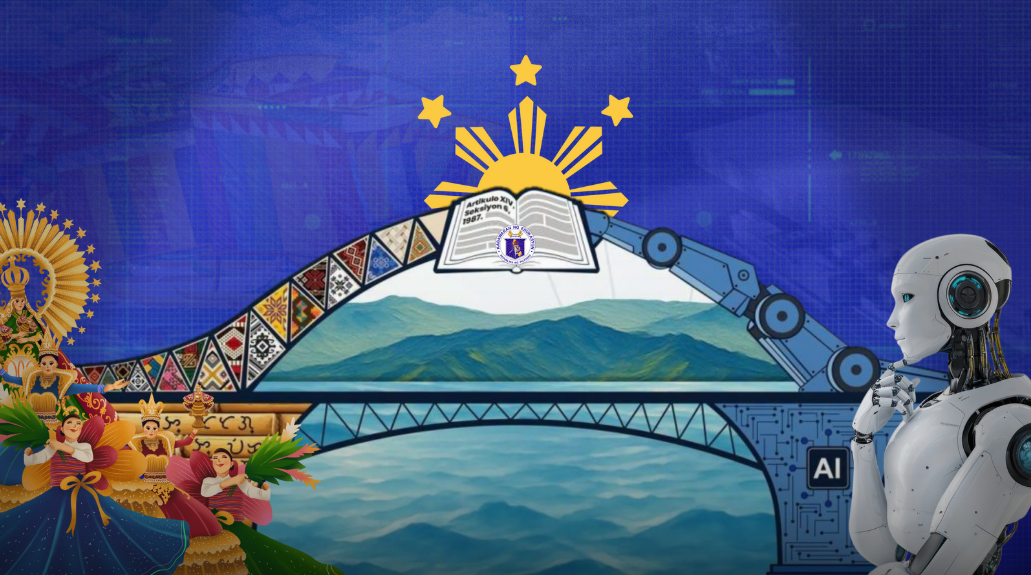
Amidst the age of anti-intellectualism, centering artificial intelligence (AI) around Buwan ng Wika 2026 as a theme, is an interesting step. Ano kayang thought process?
“E ‘di ikaw na matalino!” If you have heard this line before, you are most definitely a victim of anti-intellectualism or colloquially termed, ‘smart-shaming’. It is defined by EBSCO as the belief that individuals embodying intellectual thoughts and critical thinking are out of touch of everyday life, hence’ the feeling of contempt and skepticism towards them.
Those who are ‘anti-intellectuals’ have the perspective that practical knowledge are often more valuable than critical thought. This is because they ‘honed’ skills through experience, so they do not see what is the need to bother with lengthy processes to learn and have deeper understanding about things. The point of anti-intellectualism is why complicate things when you can use common sense? It assumes that people who think between the lines are impractical and detached from reality.
Meanwhile, it has also been proven by many researchers, such as the Kosmyna et al., (2025) study, that artificial intelligence’s influence has also extended to affecting people’s critical thinking. To test this myself, I figured I needed a testimony from the most popular AI itself. Therefore, I sent a prompt to ChatGPT asking whether using tools like them are possibly deteriorating our ability to think critically and comprehend things. The AI provided me a lengthy answer saying that it does not simply because people use AI, but because of how it is utilized—‘consistently doing the thinking for you.’ This leads us to the idea of ‘cognitive offloading’, which is the reduction of required information processing of a task by using physical actions or technology. This risks disinformation being perceived as facts, which the most vulnerable are the elderly and those who deny higher education.
The connection between AI’s impact, particularly on our thinking, alongside the continued surge of anti-intellectualism poses significant hardships in understanding global issues and information in general. And for progress and healthy conversations to develop, innovative thinking and educated discourse are needed.
By integrating AI to the commemoration of our national language just because we need to keep up with the times is a threat to Filipinos’ brainpower. Let’s admit it—Filipinos are prone to false information, often taking make-believe statements as true to validate their iron-clad beliefs. To make it worse, identifying AI-generated videos are also difficult for those who are not aware of how it works. The good thing is that AI is still affluent with the language. It makes grammatical and pronunciation mistakes. Just by hearing the sounds of my grandfather’s phone when he is watching reels is already enough for me to identify if he is watching ‘AI slop’. Even if those very vulnerable to technological advances may struggle with identifying AI-generated media, there are still people who are able to tell which is true and which is not based on how they use the Filipino language.
It could be that the reason as to why the theme revolves around modernization is to call for paving way for the language to have a space in the digital world. The contexts only the Filipino language can explain may be compromised. The relatability and conection of Filipino users towards technology, as they have to utilize English for the AI to better understand. There would be a lack of connection and representation of Filipinos and their language in the modern world.
Nevertheless, it does not erase that in the past years, Buwan ng Wika heavily gave emphasis on the language’s role in unity, cultivation of culture, and importance of appreciating indigenous languages. The Filipino language is what makes us Filipinos, truly Filipinos. For a month reserved for recognition of the national language, the most fitting theme would have been about misinformation and disinformation. Not only because these things cause division among the public, but also is relevant to AI contributing to these anomalies. The trendiness is still there and it actually educates the people, especially the learners, about the importance of being mindful when they encounter information. It is better to improve cognitive skills while people are young for them to continuously improve it while they grow older. Additionally, the theme in 2024 (Filipino: Wikang Mapagpalay) is firm that the Filipino language liberates us from the possibility of lack of knowledge.
The inclusion of AI in Buwan ng Wika only amplify anti-intellectualism. This tool normalizes the reduction of our thinking process because it makes intellectual labour easier to outsource as people use it as a substitute for thinking—reinforcing the question, ‘Why think when AI can do it for me?’. This is extremely parallel to the mentioned mentality. It refuses to ‘complicate’ things, it denies the need for deeper context. This means that existence of false information would also be intensified with AI and anti-intellectualism on the rise.
If a culture is deeply embedded with anti-intellectualism, treating critical inquiry as impractical or pretentious, AI can make it easier to bypass the effort altogether. It does not merely make information accessible. When misused, it may normalize the idea that thinking and understanding an idea by thinking for oneself is unnecessary. In a country already struggling with division and disinformation, the integration of AI and Buwan ng Wika is not innovation. It is simply adapting to what is technologically trendy. This undermines Buwan ng Wika’s purpose—for people to value their language, to discern, and comprehend.